Freelance invoice templates by profession
By the Billebly team · Published 6 May 2026 · Last updated 28 September 2026
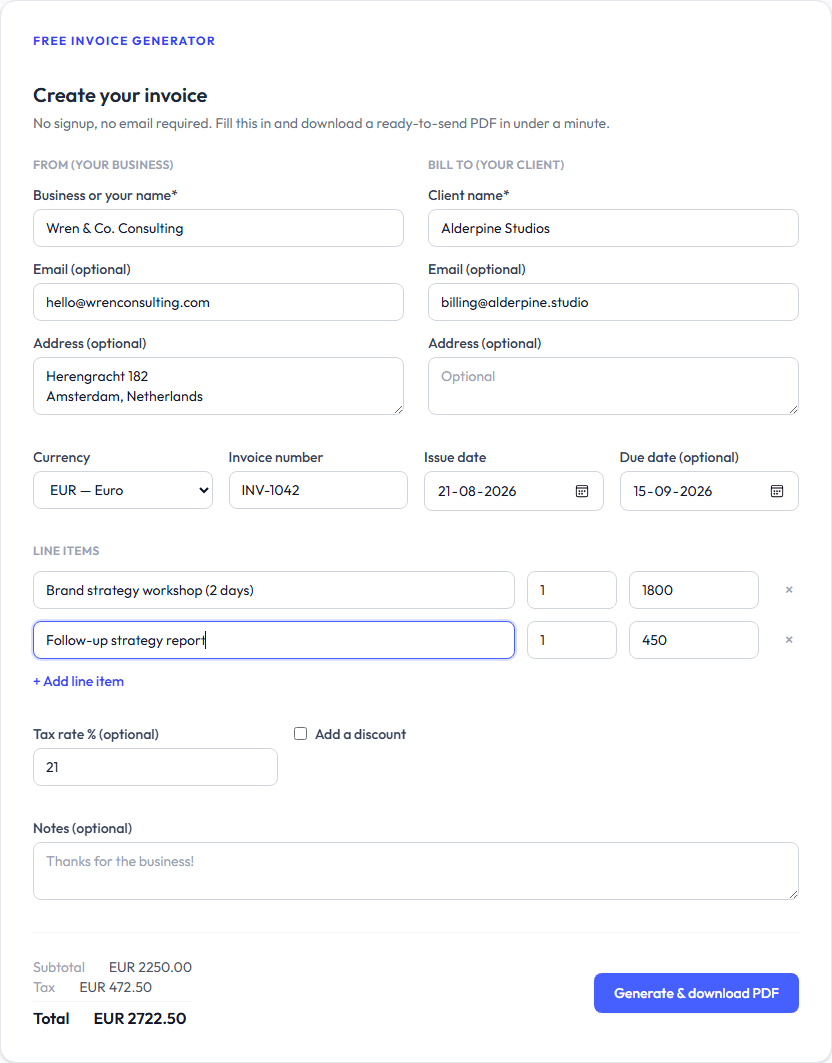
A generic freelance invoice template gets you most of the way there: your name, the client's name, a total due. What it doesn't do is tell a client what they're actually paying for. A consultant billing by the day, a coach billing per session package, and a designer billing for revisions need the same core fields, but the line items, billing model, and extra details that stop a client from questioning the invoice are specific to the work.
Why "one invoice template" doesn't hold up
The required fields (invoice number, dates, totals, payment details) don't change based on your profession. What changes is the layer underneath: how you describe the work and structure the price for it. "Consulting services, €4,000" or "coaching, €4,000" gives a client nothing to check the charge against. The fix isn't a fancier template. It's matching the line-item structure to how the work actually happened: by phase, by session, by round, or by hour.
That example shows the pattern worth copying: the line item names the actual engagement (a brand strategy workshop, not "consulting"), the rate is visible, and the total is the last thing on the page, not something the client has to add up themselves.
Consultants: bill by phase, not by generic hours
Consultants usually work in one of two modes: a day rate for a defined engagement, or hourly for open-ended advisory work. Either way, the mistake is collapsing a multi-week engagement into a single line. "Consulting, 2 weeks" tells the client nothing about what happened in that time or what they're paying for.
Break it out by phase or by deliverable instead:
- Discovery & stakeholder interviews (3 days): €3,600
- Strategy workshop, June 3 to 4: €2,400
- Final recommendations deck & presentation: €1,800
Each line maps to something the client can point to on their calendar. If you're billing hourly instead of by phase, keep the hours and rate visible rather than folding them into a lump sum: "22 hrs @ €150/hr: market research and competitor analysis" holds up to scrutiny in a way "€3,300 for research" doesn't.
The extra field that matters: engagement scope reference
Consulting invoices benefit from a line referencing the statement of work or proposal the engagement was scoped under ("Per SOW dated May 1"). It's what a client's finance team uses to reconcile the invoice against what was actually authorized. A consultant invoice template already has a field for this, so you're not adding it by hand on every invoice.
Coaches: bill the package, not the hour
Coaching rarely gets billed hour by hour the way consulting sometimes does. Most coaches sell a package (six sessions over three months, a monthly retainer for ongoing check-ins), and the invoice should reflect that package, not a per-hour breakdown that makes the relationship look transactional.
A coaching invoice usually looks like this:
- 6-session coaching package (June to August): €1,800
- Includes: bi-weekly 60-min sessions + async check-ins between sessions
Or for ongoing monthly work:
- Monthly coaching retainer, August: €650
- 2 sessions (Aug 4, Aug 18) + unlimited email support
Notice neither example itemizes each session at its own rate. That's deliberate: a client who bought a package doesn't need "€300 x 6" spelled out, they need confirmation the package they paid for is the package they're being billed for. If a client asks for a session-by-session breakdown, add a line noting dates, but leading with per-session pricing invites negotiation on individual sessions instead of the package.
Note the coverage period, not just the total
Whether you bill per package or per month, put the date range the invoice covers somewhere visible near the top. "August 2026 retainer" tells a client immediately whether this invoice is for the month they think it is. Without that, monthly retainer invoices are easy to mix up with the previous or next one.
If most of your billing is packages or retainers rather than one-off sessions, a coaching invoice template sets the package/coverage-period fields up by default instead of you rebuilding that structure every billing cycle.
Freelance designers: itemize the rounds, not just the hours
Design work has a problem consulting and coaching don't: scope creep hides inside "revisions." A client who doesn't see revision rounds itemized has no signal that round four is outside what they paid for, and you have no record to point to when they push back on an added fee.
A clear design invoice separates the base deliverable from the revision work:
- Homepage redesign (initial concept + 2 included revision rounds): €2,200
- Additional revision round (round 3, requested outside scope): €350
- Final file delivery (source files + exports): included
For ongoing design retainers, itemize by output instead of by hour where possible:
- Monthly design retainer, June: €1,400
- Includes: 8 social graphics, 1 email template, 2 revision rounds per asset
The pattern in both cases is the same: name what's included by default, then bill anything past that as its own line. That's what turns "why is this extra €350 on here" into a client already knowing the answer before they ask.
The extra field that matters: file/usage rights delivered
Designers should also note what's being delivered with the final invoice: source files, export formats, usage rights (personal use vs. commercial vs. resale). Stating it removes a common post-invoice question about whether the client actually owns what they paid for. A freelance designer invoice template has a spot for this built in.
Build the right line items once, reuse them every time
Set up the itemization that fits your work, then generate a matching invoice in under two minutes, free, no account needed.
Side by side: what actually differs
| Profession | Typical billing model | What to itemize | Common extra field |
|---|---|---|---|
| Consultant | Day rate or hourly, by engagement phase | Phases or deliverables with dates, hours + rate if hourly | SOW/proposal reference |
| Coach | Session package or monthly retainer | Package name + coverage period, not per-session pricing | Coverage period / dates included |
| Designer | Fixed project fee or retainer | Base deliverable vs. revision rounds beyond scope | Files & usage rights delivered |
The columns look different, but the underlying rule is the same: a client should be able to read your invoice and know exactly what they paid for without emailing to check. If you haven't nailed that down yet, what makes clients pay invoices on time covers the wording and structure that applies across all three.
If you work across more than one billing model
Plenty of freelancers don't fit neatly into one row of that table: a designer who also does strategy consulting, a coach who occasionally bills hourly for one-off calls. Don't force every invoice into the same shape. Keep a couple of templates on hand and pick the one that matches how that engagement was actually billed. A general freelance invoice template works fine as the default for anything that doesn't fit a specific profession's pattern.