How to write an invoice clients actually pay on time
By the Billebly team · Published 10 February 2026 · Last updated 23 August 2026
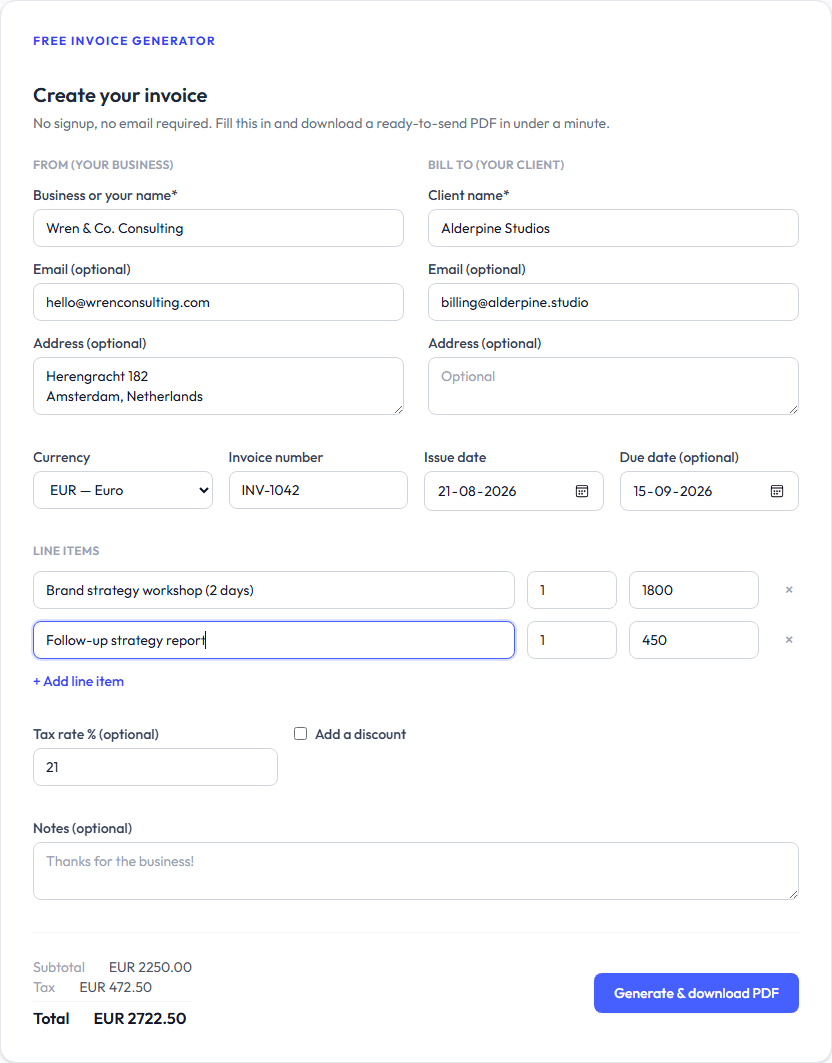
A client staring at your invoice trying to figure out what "balance due" actually covers is not going to pay it today. Confusion stalls payment just as reliably as a client who's genuinely trying to avoid paying, and it's the easier one to fix: spell out every field before they have to ask about it.
The fields an invoice can't be missing
Before you touch wording or formatting, get the required fields right. Miss one of these and you're guaranteeing a reply email instead of a payment.
- Your business name and contact details: legal name, address, email, phone
- The client's name and billing details: exactly as they'd expect to see them on their end
- A unique invoice number: sequential, never reused
- The invoice date and a due date (a date, not "within 14 days")
- An itemized list of what you're billing for: not a single lump sum
- Quantity, rate, and subtotal for each line item
- Tax, if applicable: rate and amount shown separately
- The total amount due, in the currency you expect payment in
- How to pay: bank details, a payment link, or both
If you don't want to build this from scratch every time, a freelance invoice template already has these fields laid out so you're not reinventing the structure on deadline day.
The invoice number matters more than it looks like it should
It's the field people skip most often, and the one a client's accounts team relies on most. Without a number, there's nothing to reference in an email or their own bookkeeping, so questions come back to you instead of getting resolved on their end. If you're not numbering consistently yet, a proper numbering system fixes that in about ten minutes and keeps your records straight at tax time.
Be specific about what you actually did
"Consulting services" is not a line item. It's an invitation for a question. A client reading that has no way to check it against what they agreed to, so they either pay slowly while they figure it out, or email you and wait for a reply.
Compare vague wording to specific wording:
| Vague | Specific |
|---|---|
| Consulting services | Brand strategy workshop, 2 days, June 3 to 4 |
| Design work | Homepage redesign: 3 revision rounds, final files delivered |
| Hours (June) | 14 hrs @ €85/hr: content calendar + 6 blog drafts |
| Retainer fee | Monthly retainer: social media management, June |
The specific version tells the client exactly what they're paying for without needing to ask. It also protects you: "consulting services" gives you nothing to point to if a charge gets disputed, but "brand strategy workshop, June 3 to 4" is something you can back up with a calendar entry or a signed proposal.
If you tracked time, show the hours and the rate, not just the total. If you agreed a fixed fee, describe the deliverable, not the effort. Clients don't want to see your hours if they didn't pay hourly. And if you're not sure whether what you sent earlier was a quote, an estimate, or something that should have been invoiced, it's worth reading how a quote, an estimate, and an invoice differ. Sending the wrong one is a common reason invoices get questioned.
That's what a complete invoice looks like: business details and client details clearly separated, line items a client can check against their own notes, and a total that adds up without a calculator. Nothing about it requires a follow-up email.
Put the due date where it can't be missed
A due date buried in a paragraph gets skimmed past. Put it in its own line, near the top, in the same visual weight as the total due. "Payment due within 30 days" is worse than a fixed date. "Due: June 30, 2026" removes the need to do math against whatever date the email happens to get opened.
Use a fixed date, not a countdown
"Net 30" and "due in 30 days" both force the client to calculate the actual date. A fixed due date removes that step and removes the ambiguity if the invoice sits unopened for a few days before they read it.
Payment terms matter for the same reason. If you invoice net 14 or net 30, say so on every invoice, not just in the original proposal, because clients forget what was agreed weeks earlier. Restating it costs one line and saves a "wait, when was this due again?" email.
Make paying a single click, not a scavenger hunt
Even a perfectly worded invoice slows down if paying it means the client has to dig up your bank details from a separate email thread. A hosted invoice with a pay-now link removes that step. The client clicks through and pays, instead of copying an IBAN into their banking app and hoping they typed it correctly.
This is also where a lot of the "late payment" problem actually lives. Plenty of invoices that read as overdue aren't being ignored. They're sitting in a queue because paying them took more effort than the client had time for that day. For the fuller picture, including follow-up timing and payment friction, see what gets freelancers paid faster.
Stop rebuilding invoices from scratch
Generate a clean, complete invoice with all the required fields in under two minutes, free, no account needed.
Match the invoice to how you actually work
A one-off project invoice, a retainer invoice, and an hourly invoice all need the same core fields, but what matters most differs by type. A retainer invoice needs the billing period front and center. An hourly invoice needs the rate and hours itemized, not collapsed into a total. A project invoice needs the deliverable named, not the hours spent producing it.
If you bill across a few formats (hourly for some clients, fixed fee for others, retainers for a couple more), keep a separate template for each rather than reshaping one invoice every time. There's a breakdown of invoice templates by profession that matches format to the kind of work, whether that's coaching sessions, design retainers, or consulting projects billed by the day.
Read it once as if you were the client
Before you send anything, read the invoice as if you're the person receiving it, not the person who did the work. Can you tell what you're being charged for without checking anything else? Is the total obvious without adding line items by hand? Is the due date the first thing you'd notice, or the last? If you have to think about any of those, so will your client, and that hesitation is what turns a same-day payment into one you're chasing next week.