Billability: what it is, how to calculate it, and what a good rate looks like
By the Billebly team · Published 24 October 2026
Billability is the percentage of your working time that ends up as billable work for a client. If you worked 40 hours this week and 26 of them were client work you can invoice, your billability is 65%. It's one of the few numbers that explains why a perfectly reasonable hourly rate can still leave you short at the end of the month: the rate is only ever paid on the billable share of your week, never on all of it.
The billability formula
Billability = billable hours ÷ total available hours × 100
- Billable hours are hours you can put on an invoice: client work inside the agreed scope, or extra work the client has agreed to pay for.
- Total available hours are the hours you actually had to work with in that period. Most freelancers use hours worked; agencies usually use contracted capacity (for example 40 hours a week minus holidays and sick days).
Pick one denominator and stick with it. Measuring against hours worked tells you how much of your effort turns into revenue. Measuring against capacity also exposes quiet weeks, since an empty afternoon counts against you instead of disappearing from the sum.
A worked example
Say a freelance developer logs this week:
| Activity | Hours | Billable? |
|---|---|---|
| Client A: feature work | 18 | Yes |
| Client B: bug fixes | 7 | Yes |
| Client B: call that ran over scope | 1 | No, written off |
| Sales calls and proposals | 5 | No |
| Admin, invoicing, bookkeeping | 4 | No |
| Learning a new framework | 3 | No |
| Total | 38 |
Billable hours: 18 + 7 = 25. Billability: 25 ÷ 38 × 100 ≈ 66%.
At €80 an hour, that's €2,000 invoiced for 38 hours of work, or an effective rate of about €53 an hour across the whole week. That gap between the rate you quote and the rate you actually earn is what billability measures.
Billability vs. utilization vs. realization
These three terms get used interchangeably, but they measure different things, and the difference matters once you start tracking them.
| Metric | What it measures | Formula |
|---|---|---|
| Billability | Share of time spent on work that can be billed | Billable hours ÷ available hours |
| Utilization | Share of time spent on any client or productive work, billed or not | Client hours ÷ available hours |
| Realization | Share of billable work that actually got invoiced and paid | Hours invoiced ÷ billable hours |
In practice most freelancers and small agencies say "utilization rate" or "billable utilization" and mean billability. Realization is the one people forget: a 75% billability rate doesn't help much if a fifth of those hours never make it onto an invoice because they weren't logged or got discounted away.
What's a good billability rate?
There's no single right number, but these ranges are typical:
- Freelancers and solo consultants: 50-70%. You do your own sales, admin, and invoicing, so a big slice of the week can never be billed. Consistently above 75% usually means you've stopped doing the sales work that keeps next quarter full.
- Agency and consultancy delivery staff: 70-85%. Someone else handles sales and admin, so delivery roles are expected to bill most of their time.
- Agency leads and managers: 30-60%. Their job is partly running the team, so lower billability is expected, not a problem.
The more useful benchmark is your own trend. A billability rate that slides from 65% to 50% over three months is worth looking into, even if 50% would be fine for someone else.
Billability belongs in your rate, not just your reports
If you price assuming 40 billable hours a week, you're quietly overestimating your income by 30-50%. Plug your real billability into the freelance rate calculator and it works out the hourly rate you need at the share of your week you actually bill.
How to improve your billability
- Track all your time, not just client time. You can't calculate billability from billable hours alone. Log admin, sales, and learning too, even roughly, so the denominator is real.
- Agree on what's billable up front. Calls, revisions, and travel are where unbilled hours pile up. Spell out in your contract which of them you charge for. Freelance contract essentials covers the clauses that prevent most scope disputes.
- Bill scope creep instead of absorbing it. The "quick extra change" is billable work. Log it as billable and either invoice it or make a deliberate decision to write it off.
- Cut the admin that doesn't need to exist. Rebuilding a timesheet from memory, chasing payments by hand, and retyping hours into an invoice all count against your billability. Connecting online time and billing removes most of it.
- Don't push it to 100%. Sales, learning, and rest are what keep your billable hours coming next quarter. Aim for a stable rate you can sustain, not the highest one you can hit for a month.
Track billable and non-billable hours in one place
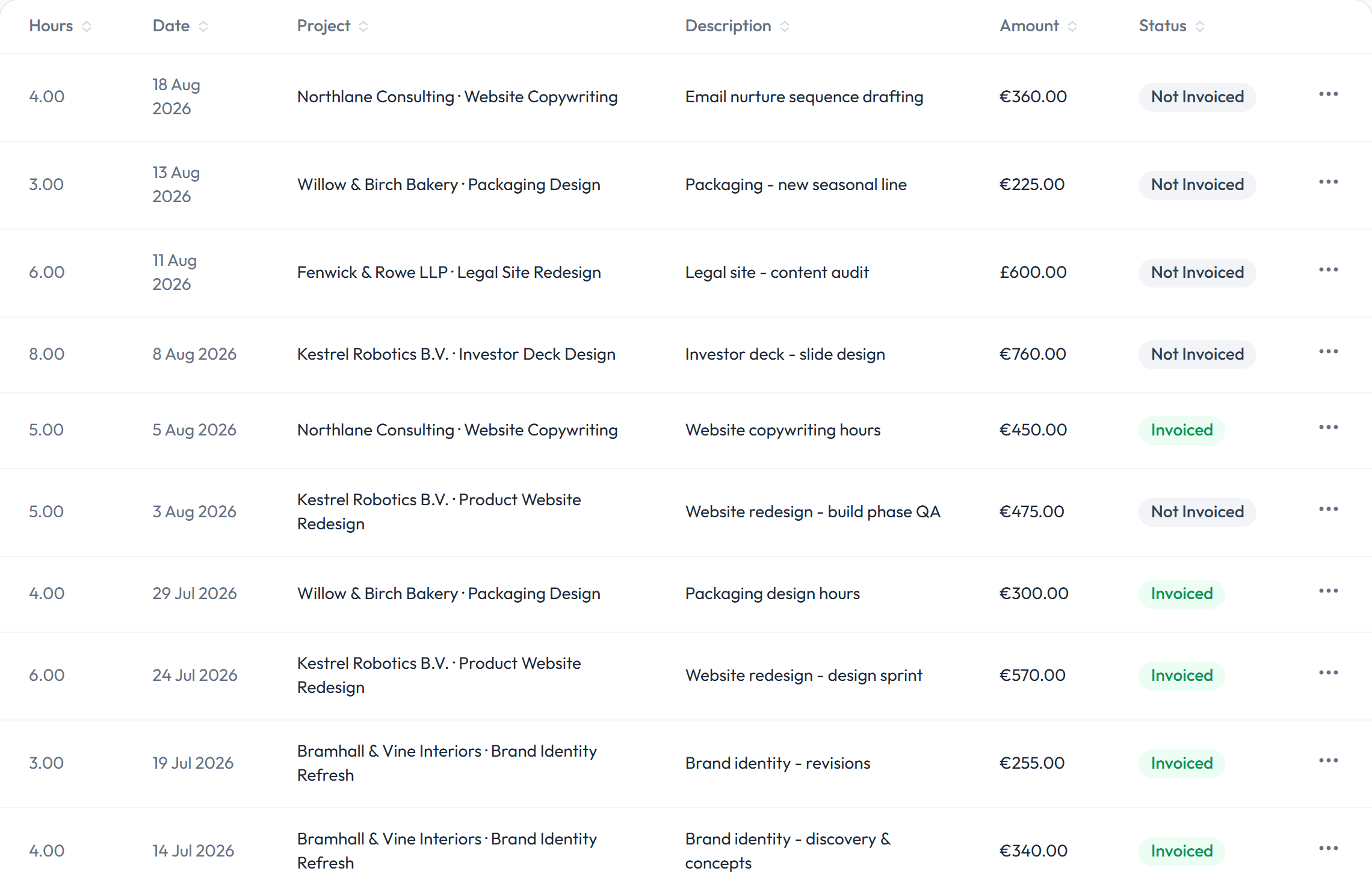
Billebly lets you log time against each client's projects and mark entries as billable or non-billable, so you can see what share of your week is invoiceable. When it's time to bill, the billable hours go straight onto an invoice, which keeps your realization up as well: hours you logged can't quietly drop off before they reach the client.
See how much of your week you actually bill
Log billable and non-billable time per client, then turn the billable hours into an invoice, in the same free account.